4
min read

Most eCommerce founders are working harder than they need to. Not because they lack skill. Not because they lack drive. Because they picked the wrong vehicle for the skills they already have.
This is the skill-to-opportunity mismatch. And it kills more businesses quietly than bad products ever will.
The Mountain You Chose vs. The Mountain You Should Climb
Think about how an eCommerce business actually gets built. You find a product, source it, brand it, market it, fulfill it, handle returns, manage suppliers, fight margins, and repeat. Every step is a mountain of its own.
Now ask yourself: is this the best use of your specific skills?
If you are a great designer, you are spending most of your time on logistics, ads, and customer service. The actual skill you have, design, accounts for maybe 10% of your day. The other 90% is overhead that has nothing to do with why you are good at what you do.
That is the mismatch.
You are pouring time, money, and energy into a vehicle that was never built for your skill set. And somewhere out there, a better path exists. You just are not on it.
What You Already Have That You Are Not Monetizing
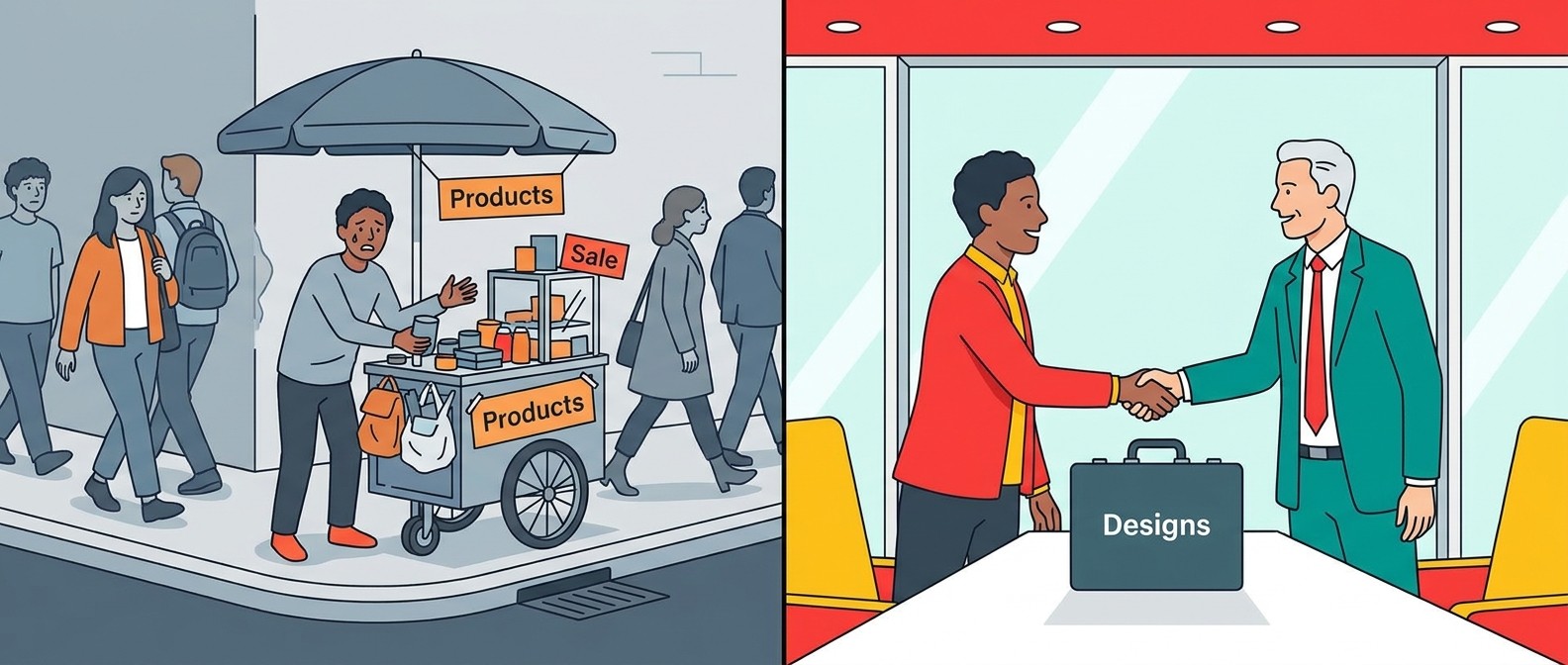
Here is how this actually plays out.
Say you are good at graphic design. You started an eCommerce brand because you wanted to put your work on products. Makes sense. But now you are managing a Shopify store, running Meta ads, dealing with shipping delays, and answering support tickets. None of that is design.
The hidden asset? Your design capability itself.
A single client, one brand that already generates consistent revenue, will pay $35,000 to $150,000 for a licensed design system or an ongoing creative retainer. Not because your designs are magic. Because they are using your output to sell their products at scale, and your skill is worth more inside their engine than it is inside yours.
You do not need to build the mountain. You need to find someone already at the top and offer them what they need to stay there. In practice, that means identifying brands already doing significant revenue and positioning your skill as something they need to keep growing, rather than competing against them by building your own brand from scratch.
Why the B2B Path Creates More Leverage
Samsung is one of the clearest examples of this logic at work.
On the surface, Samsung and Apple are competitors. Rival brands. Different ecosystems. But behind the scenes, Samsung manufactures a significant portion of Apple's displays. For years. Because Samsung is exceptional at building screens, and Apple needs the best screens available to sell the best phones in the world.
Samsung did not dilute its capability by trying to out-Apple Apple. It found the company that was already winning and became indispensable to their operation.
Your eCommerce brand can work the same way.
If you are great at sourcing, find brands that need sourcing infrastructure. If you are great at fulfillment operations, offer that as a service. If you have a loyal audience, license access to it. The business you built is not just a store. It is a set of capabilities with market value far beyond what your products alone can generate.
The Real Opportunity Is the One You Are Already Pursuing
This is the part that surprises most founders.
The opportunity that will actually scale your business is usually the same opportunity you are already working on. You are just pursuing it in the wrong structure.
Instead of only creating products for your own brand, create for other brands. Instead of only fulfilling your own orders, offer fulfillment as a service. Instead of only growing your own audience, monetize access to it.
The skill is not the problem. The vehicle is. The vehicle is the business model you chose to deliver your skill through. In this case, a product brand that requires you to handle logistics, ads, fulfillment, and customer service just to get your actual capability in front of one customer.
You do not need to start over. You need to look at what you have built and ask: who else would pay for this, and what would that relationship look like?
The answer is usually sitting in front of you. You just have not priced it yet.
What To Do With This
Identify your actual skill. Not what your business does. What you specifically do better than most people in your space.
Find the hidden asset. What part of your operation has standalone value? Sourcing relationships, audience trust, creative output, operational systems?
Locate the buyer. Who is already at scale and needs what you have? That is your B2B opportunity.
Build the revenue stream. Licensing, retainers, white-label services, co-manufacturing, audience partnerships. The structure follows the asset.
You built something real. The question is whether you are getting paid for all of it.

Written by Jay Luciano
